Annals of Middle Eastern Medicine
Norah I. Almanie et al. Annals of Middle Eastern Medicine. 2026;2(2):152-161
ORIGINAL ARTICLE
Knowledge gaps and health practices related to polycystic ovary syndrome among women in Southwestern Saudi Arabia: a cross-sectional study
Norah I. Almanie1, Sohaila Ahmed Asiri2*, Taif Khalid Alasmari2, Norah Saad Jadaan2, Thikra Khalid Alasmari2, Yusra Abdullah AlQasimi2, Ayman Shaamash1
Correspondence to: Sohaila Ahmed Asiri
*Medical Intern, College of Medicine, King Khalid University, Abha, Saudi Arabia.
Email: sohaila6f@gmail.com
Full list of author information is available at the end of the article.
Received: 23 March 2026 | Revised (1): 15 April 2026 | Revised (2): 20 April 2026 | Accepted: 28 April 2026
ABSTRACT
Background:
Polycystic ovary syndrome (PCOS) is a prevalent endocrine disorder affecting 4% to 20% of reproductive-age women globally. Despite its health consequences, data on PCOS awareness and practices remain limited in Saudi Arabia, particularly outside major urban centers. This study assessed PCOS knowledge and health-related practices among women in the Asir region and examined sociodemographic determinants of knowledge and its relationship with health behaviors.
Methods:
This cross-sectional study surveyed 528 women aged ≥18 years in the Asir region using a validated online questionnaire (Cronbach’s alpha: 0.904 for knowledge; 0.896 for practices; KR-20 = 0.909). Chi-square, Kruskal–Wallis, Spearman’s correlation, and multiple linear regression assessed sociodemographic, knowledge, and practice associations (p < 0.05).
Results:
Overall, 45.1% demonstrated poor PCOS knowledge (score ≤ 10), 38.1% moderate, and 16.9% good. While 83.9% had heard of PCOS and key symptoms, including menstrual irregularity (83.5%) and hirsutism (67.8%), were recognized, cardiometabolic complication awareness was low (diabetes: 28.6%; cardiovascular disease: 13.8%). Binary logistic regression identified older age (OR = 0.614, 95% CI: 0.465-0.810, p < 0.001), lower educational attainment (OR = 1.242, p = 0.011), and marital status (OR = 1.625, p = 0.030) as independent predictors of inadequate knowledge. PCOS knowledge independently predicted practice scores (β = 0.261, p < 0.001).
Conclusion:
Substantial gaps in PCOS knowledge and suboptimal health practices persist among women in southwestern Saudi Arabia. Older age and lower education were the strongest predictors of inadequate knowledge. Greater knowledge correlated with healthier practices, highlighting the need for targeted educational interventions addressing cardiometabolic risks, promoting early diagnosis, and improving outcomes.
Keywords:
cross-sectional study, health practices, knowledge, polycystic ovary syndrome, Saudi Arabia.
Introduction
Polycystic Ovary Syndrome (PCOS) is a prevalent endocrine disorder affecting 4%-20% of women of reproductive age, with this broad range largely attributable to inconsistent application of diagnostic criteria across studies [1,2]. Regional estimates vary considerably; a recent cross-sectional study from the Western region of Saudi Arabia reported a prevalence of approximately 31.8%, suggesting the burden may be substantially higher in Gulf populations than global figures imply [3,4]. Diagnosis in adults is based on the Rotterdam criteria, requiring at least two of the following three features: oligovulation and/or anovulation, clinical or biochemical hyperandrogenism, and polycystic ovaries on ultrasound [5]. Hyperandrogenism commonly manifests as hirsutism, acne, or androgenic alopecia, while ovulatory dysfunction underlies the infertility that brings the majority of affected women to clinical attention. In adolescents, maintaining a high index of suspicion is especially important, as early diagnosis enables timely initiation of lifestyle and pharmacological therapy before long-term complications accrue [5,6].
Despite its prevalence, PCOS awareness remains limited at both the clinical and community levels. Even in well-organized healthcare systems, diagnostic consistency and recognition of psychosocial comorbidities remain suboptimal among healthcare professionals, with inconsistent application of the Rotterdam criteria documented across Northern European obstetric and endocrine units [7]. At the community level, awareness is markedly poor: only 21.7% of women surveyed in the United Arab of Emirates (UAE) demonstrated sufficient knowledge of the syndrome [8], and a study from the Western region of Saudi Arabia found that merely 2.9% of participants achieved a good level of awareness [3], underscoring how limited public understanding remains even in populations with accessible healthcare infrastructure.
The consequences of unrecognized PCOS extend well beyond reproductive dysfunction. Infertility and psychological comorbidities, including depression and anxiety, are frequently underrecognized [7], while women with PCOS exhibit higher rates of impaired glucose metabolism, insulin resistance, and adverse lipid profiles compared with controls with cardiometabolic markers progressively worsening with advancing age [9], Women with metabolic disorders (known as metabolic syndrome) carry twice the likelihood of a PCOS diagnosis [10], underscoring the compounding burden of unmanaged disease. Critically, a national Saudi study reported that 28.6% of women waited six months or more to receive a diagnosis after first seeking care, and only 42.7% received adequate information at the time of diagnosis [11], highlighting persistent gaps in both diagnostic pathways and patient education that justify further region-specific investigation.
These findings collectively identify a need for locally grounded data to inform targeted public health strategies. Accordingly, this cross-sectional study aimed to assess PCOS knowledge and health-related practices among women aged ≥18 years in the Asir region of Saudi Arabia, and to examine sociodemographic determinants of knowledge and its relationship with reported health behaviors.
Material and Methods
Study design and setting
This cross-sectional observational study was conducted in the Asir region of Saudi Arabia from September to November 2024.
Sample size, population, and sampling technique
Participants were recruited using a non-probability convenience sampling approach with snowball distribution via an online self-administered questionnaire shared through social media platforms and electronic messaging groups. Participation was voluntary and anonymous. Although this method enabled efficient recruitment, it may introduce selection bias and limit sample representativeness [3,11].
Based on regional statistics, the number of females of childbearing age (15-45 years) in the Asir region in 2024 was estimated at 581,294 [12-14]. The required sample size was calculated using Yamane’s formula [15], yielding a minimum of 385 participants at a 95% confidence level and a 5% margin of error. A total of 528 women completed the survey, exceeding the minimum requirement. Inclusion criteria were female, residency in the Asir region, age ≥18 years, and provision of informed consent. Exclusion criteria included questionnaires that were incomplete, duplicated, or contained inconsistent or implausible data that prevented reliable analysis.
Data collection and study tool
Data were collected using an author-developed online questionnaire, reviewed by two subject-matter experts, and pilot-tested among thirty women prior to full deployment. The survey was created in Google Forms and distributed in both Arabic and English. It comprised three sections: (I) sociodemographic characteristics (age, marital status, education, and employment); (II) PCOS knowledge, covering awareness, androgen hormones, complications, and treatment options (20 binary items); and (III) health-related practices, including dietary habits and physical activity (A ten items using 5 Likert-scale). Knowledge items were scored binarily (correct = 1, incorrect/do not know = 0), yielding a total score of 0-20, categorized as poor (≤10), moderate [11-15], or good [16-20]. Health-related practice items used a five-point Likert scale (1 = Never to 5 = Always), yielding a total score of 10-50, categorized by tertiles as poor (≤23), moderate (24-34), and good (>34). The knowledge section yielded Cronbach’s α = 0.904 and KR-20 = 0.909; the practices section yielded α = 0.896; and the full 30-item instrument yielded α = 0.881. Corrected item-total correlations exceeded the 0.20 threshold for all items (knowledge: 0.289-0.719; practices: 0.480-0.806). Content validity was confirmed by two specialist reviewers, and construct validity was supported by significant domain–total correlations across six knowledge domains (R = 0.576-0.774, all p < 0.001). Detailed psychometric statistics are provided in Supplementary Tables 1-4.
Data analysis
Data were analyzed using SPSS version 26 (IBM Corp., Armonk, NY). Descriptive statistics were reported as frequencies and percentages for categorical variables and mean ± SD for continuous variables. Chi-square and exact probability tests assessed associations between sociodemographic factors and knowledge or practice categories. The Kruskal–Wallis test compared continuous scores across demographic groups. Spearman’s rank correlation (ρ) with 95% confidence intervals (Fisher’s Z-transformation) evaluated associations between knowledge and individual practice items. Multiple linear regression identified independent predictors of knowledge and practice scores, with standardized coefficients (β), 95% CIs, and effect sizes (Cramér’s V) reported. Binary logistic regression was additionally performed to identify independent predictors of adequate PCOS knowledge, with a dichotomized outcome (adequate: score ≥ 10/20; inadequate: score < 10/20) and five sociodemographic variables entered simultaneously as ordinal predictors; results are reported as odds ratios (OR) with 95% CIs. Statistical significance was set at p < 0.05 for all analyses.
Table 1. Sociodemographic characteristics and their association with knowledge and practice categories (N = 528).
| Variable | N | % | Knowledge χ ² (df, p , V) | Practice χ ² (df, p , V) |
|---|---|---|---|---|
| Age Group | χ² = 39.48, df = 6, p < 0.001, V = 0.193 | χ² = 7.15, df = 6, p = 0.308, V = 0.082 | ||
| 18-25 years | 157 | 29.7% | ||
| 26-35 years | 82 | 15.5% | ||
| 36-45 years | 141 | 26.7% | ||
| >45 years | 148 | 28.0% | ||
| Educational Level | χ² = 44.57, df = 12, p < 0.001, V = 0.205 | χ² = 7.53, df = 12, p = 0.821, V = 0.084 | ||
| Primary school | 21 | 4.0% | ||
| Intermediate school | 16 | 3.0% | ||
| Secondary school | 95 | 18.0% | ||
| Diploma | 69 | 13.1% | ||
| Bachelor's degree | 306 | 57.9% | ||
| Master's degree | 13 | 2.5% | ||
| PhD or equivalent | 8 | 1.5% | ||
| Marital Status | χ² = 15.31, df = 6, p = 0.018, V = 0.120 | χ² = 6.89, df = 6, p = 0.331, V = 0.081 | ||
| Single | 168 | 31.8% | ||
| Married | 335 | 63.4% | ||
| Divorced | 13 | 2.5% | ||
| Widowed | 12 | 2.3% | ||
| Employment Status | χ² = 28.97, df = 10, p = 0.001, V = 0.166 | χ² = 12.49, df = 10, p = 0.253, V = 0.109 | ||
| Student | 113 | 21.4% | ||
| Unemployed | 116 | 22.0% | ||
| Employed | 139 | 26.3% | ||
| Housewife | 102 | 19.3% | ||
| Self-employed | 8 | 1.5% | ||
| Retired | 50 | 9.5% | ||
| Monthly Household Income (SAR) | χ² = 7.90, df = 4, p = 0.095, V = 0.086 | χ² = 3.60, df = 4, p = 0.462, V = 0.058 | ||
| <3,000 SAR | 255 | 48.3% | ||
| 3,000-5,000 SAR | 60 | 11.4% | ||
| >5,000 SAR | 213 | 40.3% |
V = Cramér’s V effect size. Bold p-values indicate statistical significance (p<0.05). SAR = Saudi Riyals.
Ethical considerations
The study was conducted in accordance with the Declaration of Helsinki and approved by the Research Ethics Committee of King Khalid University (HAPO-06-B-001; Approval No. ECM#2024-2702, approved 10/09/2024). Completion of the questionnaire implied informed consent. The survey was anonymous, with no personal identifiable information collected and responses accessible only to the research team.
Results
Sociodemographic characteristics of participants
A total of 528 women residing in the Asir region completed the survey, exceeding the minimum required sample size of 385. Sociodemographic characteristics are presented in Table 1. The sample was broadly distributed across age groups, with the oldest group (>45 years) comprising 28.0% of participants. Educational attainment was high, with over half holding a bachelor’s degree or above. Most participants were married, and half reported low household income, reflecting the socioeconomic diversity of the sample.
PCOS knowledge among participants
While general symptom recognition was strong, particularly for menstrual irregularity and links to infertility and psychological comorbidities, awareness of cardiometabolic complications was strikingly poor. The high “Don’t Know” responses for heart disease and diabetes indicate that the metabolic dimension of PCOS remains invisible to the public, representing the most critical gap in disease literacy. Treatment knowledge was similarly deficient, with most participants unaware of evidence-based pharmacological options. Full item-level frequencies are provided in Supplementary Table 5.
Table 2. PCOS knowledge scores and categories by sociodemographic characteristics.
| Variable | N | Mean | SD | Poor ≤10 (%) | Moderate 11-15 (%) | Good 16-20 (%) | Kruskal-Wallis H |
|---|---|---|---|---|---|---|---|
| Age Group | H = 49.16, p < 0.001 | ||||||
| 18-25 years | 157 | 12.27 | 4.86 | 52 (33.1) | 68 (43.3) | 37 (23.6) | — |
| 26-35 years | 82 | 10.87 | 4.70 | 33 (40.2) | 38 (46.3) | 11 (13.4) | — |
| 36-45 years | 141 | 11.06 | 4.80 | 56 (39.7) | 59 (41.8) | 26 (18.4) | — |
| >45 years | 148 | 8.22 | 5.32 | 97 (65.5) | 36 (24.3) | 15 (10.1) | — |
| Educational Level | H = 45.12, p < 0.001 | ||||||
| Primary school | 21 | 6.48 | 3.80 | 19 (90.5) | 2 (9.5) | 0 (0.0) | — |
| Intermediate school | 16 | 5.38 | 5.35 | 12 (75.0) | 3 (18.8) | 1 (6.2) | — |
| Secondary school | 95 | 10.83 | 5.16 | 40 (42.1) | 39 (41.1) | 16 (16.8) | — |
| Diploma | 69 | 9.17 | 5.29 | 41 (59.4) | 20 (29.0) | 8 (11.6) | — |
| Bachelor’s degree | 306 | 11.20 | 4.93 | 123 (40.2) | 127 (41.5) | 56 (18.3) | — |
| Master’s degree | 13 | 12.69 | 4.46 | 2 (15.4) | 7 (53.8) | 4 (30.8) | — |
| PhD or equivalent | 8 | 14.75 | 4.27 | 1 (12.5) | 3 (37.5) | 4 (50.0) | — |
| Marital Status | H = 21.89, p < 0.001 | ||||||
| Single | 168 | 12.12 | 4.90 | 60 (35.7) | 68 (40.5) | 40 (23.8) | — |
| Married | 335 | 9.89 | 5.21 | 165 (49.3) | 123 (36.7) | 47 (14.0) | — |
| Divorced | 13 | 10.77 | 3.83 | 5 (38.5) | 7 (53.8) | 1 (7.7) | — |
| Widowed | 12 | 8.67 | 5.21 | 8 (66.7) | 3 (25.0) | 1 (8.3) | — |
| Employment Status | H = 35.14, p < 0.001 | ||||||
| Student | 113 | 12.45 | 4.50 | 35 (31.0) | 51 (45.1) | 27 (23.9) | — |
| Unemployed | 116 | 10.68 | 5.28 | 55 (47.4) | 42 (36.2) | 19 (16.4) | — |
| Employed | 139 | 10.79 | 5.31 | 56 (40.3) | 56 (40.3) | 27 (19.4) | — |
| Housewife | 102 | 9.00 | 5.14 | 56 (54.9) | 36 (35.3) | 10 (9.8) | — |
| Self-employed | 8 | 12.75 | 4.03 | 2 (25.0) | 4 (50.0) | 2 (25.0) | — |
| Retired | 50 | 8.56 | 4.78 | 34 (68.0) | 12 (24.0) | 4 (8.0) | — |
| Monthly Income (SAR) | H = 6.28, p = 0.043 | ||||||
| <3,000 SAR | 255 | 11.11 | 5.06 | 103 (40.4) | 106 (41.6) | 46 (18.0) | — |
| 3,000-5,000 SAR | 60 | 9.53 | 5.32 | 36 (60.0) | 16 (26.7) | 8 (13.3) | — |
| >5,000 SAR | 213 | 10.28 | 5.24 | 99 (46.5) | 79 (37.1) | 35 (16.4) | — |
H = Kruskal-Wallis H statistic. Knowledge score range: 0-20; Poor ≤10, Moderate 11-15, Good 16-20.
Overall PCOS knowledge score and categorization
The mean knowledge score was 10.59 (SD = 5.18; median = 11.0; IQR = 7.0-14.0), falling just above the threshold for poor knowledge. The distribution was skewed toward inadequacy: half of the participants demonstrated poor knowledge, and fewer than one in six achieved a satisfactory level, underscoring the breadth of the knowledge deficit in this community.
Association between sociodemographic factors and PCOS knowledge
Statistically significant differences in knowledge were observed across all demographic variables except income (Table 2). These differences highlight that older age and lower educational attainment are the most consequential sociodemographic barriers to PCOS literacy. The steepest knowledge gap was observed in women over 45 years, who were most likely to fall in the poor knowledge category, and in those with primary or intermediate schooling. Single women and students demonstrated comparatively stronger disease awareness, reflecting greater engagement with health information through academic and social channels. Notably, income was the only sociodemographic variable not significantly associated with knowledge, suggesting that financial access alone does not drive awareness in this population. Detailed scores and statistical comparisons by subgroup are presented in Table 2.
Health-related practices among participants
Individual practice item responses are summarized in Supplementary Table 6. Overall, adherence to recommended dietary behaviors was inconsistent: consumption of fruits, vegetables, and regular exercise were the areas of greatest deficit, while fiber-rich food intake showed higher engagement. These patterns suggest that even basic preventive health behaviors remain suboptimal across the sample.
Table 3. Health-related practice scores and categories by sociodemographic characteristics.
| Variable | N | Mean ± SD | Poor ≤24 (%) | Moderate 25-35 (%) | Good ≥36 (%) | Kruskal-Wallis H ( p -value) |
|---|---|---|---|---|---|---|
| Age Group | H = 4.56, p = 0.207 | |||||
| 18-25 years | 157 | 29.54 ± 8.02 | 42 (26.8%) | 84 (53.5%) | 31 (19.7%) | |
| 26-35 years | 82 | 28.29 ± 7.58 | 28 (34.1%) | 39 (47.6%) | 15 (18.3%) | |
| 36-45 years | 141 | 28.62 ± 7.82 | 41 (29.1%) | 75 (53.2%) | 25 (17.7%) | |
| >45 years | 148 | 30.12 ± 7.27 | 30 (20.3%) | 84 (56.8%) | 34 (23.0%) | |
| Educational Level | H = 1.84, p = 0.934 | |||||
| Primary school | 21 | 29.33 ± 7.20 | 4 (19.0%) | 12 (57.1%) | 5 (23.8%) | |
| Intermediate school | 16 | 28.12 ± 6.51 | 6 (37.5%) | 8 (50.0%) | 2 (12.5%) | |
| Secondary school | 95 | 28.82 ± 7.34 | 27 (28.4%) | 50 (52.6%) | 18 (18.9%) | |
| Diploma | 69 | 28.97 ± 7.89 | 19 (27.5%) | 39 (56.5%) | 11 (15.9%) | |
| Bachelor's degree | 306 | 29.54 ± 7.75 | 78 (25.5%) | 164 (53.6%) | 64 (20.9%) | |
| Master's degree | 13 | 28.15 ± 7.82 | 5 (38.5%) | 6 (46.2%) | 2 (15.4%) | |
| PhD or equivalent | 8 | 30.25 ± 12.87 | 2 (25.0%) | 3 (37.5%) | 3 (37.5%) | |
| Marital Status | H = 1.54, p = 0.672 | |||||
| Single | 168 | 29.18 ± 7.82 | 47 (28.0%) | 91 (54.2%) | 30 (17.9%) | |
| Married | 335 | 29.37 ± 7.56 | 84 (25.1%) | 183 (54.6%) | 68 (20.3%) | |
| Divorced | 13 | 27.23 ± 9.07 | 6 (46.2%) | 3 (23.1%) | 4 (30.8%) | |
| Widowed | 12 | 29.50 ± 9.25 | 4 (33.3%) | 5 (41.7%) | 3 (25.0%) | |
| Employment Status | H = 11.58, p = 0.041 | |||||
| Employed | 139 | 28.68 ± 8.28 | 41 (29.5%) | 73 (52.5%) | 25 (18.0%) | |
| Unemployed | 116 | 28.36 ± 7.41 | 36 (31.0%) | 60 (51.7%) | 20 (17.2%) | |
| Student | 113 | 28.73 ± 7.59 | 33 (29.2%) | 64 (56.6%) | 16 (14.2%) | |
| Housewife | 102 | 30.24 ± 7.32 | 23 (22.5%) | 52 (51.0%) | 27 (26.5%) | |
| Self-employed | 8 | 28.88 ± 8.04 | 2 (25.0%) | 5 (62.5%) | 1 (12.5%) | |
| Retired | 50 | 32.24 ± 7.09 | 6 (12.0%) | 28 (56.0%) | 16 (32.0%) | |
| Monthly Income (SAR) | H = 0.32, p = 0.854 | |||||
| <3,000 SAR | 255 | 29.18 ± 7.58 | 71 (27.8%) | 134 (52.5%) | 50 (19.6%) | |
| 3,000-5,000 SAR | 60 | 29.97 ± 8.30 | 16 (26.7%) | 30 (50.0%) | 14 (23.3%) | |
| >5,000 SAR | 213 | 29.16 ± 7.70 | 54 (25.4%) | 118 (55.4%) | 41 (19.2%) | |
SD = standard deviation. Practice score range: 10-50; Poor ≤ 24, Moderate 25-35, Good ≥ 36. H = Kruskal–Wallis H statistic. Bold values indicate the group with the highest mean practice score within a significant demographic variable. *p < 0.05.
Overall health practice score and categorization
The mean practice score was 29.26 (SD = 7.71; median = 29.0; IQR = 24.0-34.0), corresponding to the moderate category. The distribution suggests that while outright poor health behavior is not the norm, truly good health practices are equally rare, with only about one in four participants achieving adequate lifestyle behaviors.
Association between sociodemographic factors and health practices
Unlike knowledge, health-related practice scores were unaffected by most sociodemographic variables; age, education, marital status, and income showed no significant associations. The one exception was employment status, where a statistically significant difference was observed (Table 3). Notably, retired women demonstrated the strongest practice behaviors, while unemployed women showed the weakest, suggesting that structured daily routines and life stage may shape health behavior more than formal education or income in this population.
Predictors of PCOS knowledge
Multiple linear regression identified two dominant independent predictors of PCOS knowledge (Table 4): advancing age and lower educational attainment. The model explained 14.0% of the variance in knowledge scores. Older age exerted the strongest negative effect, with women over 45 years scoring significantly lower even after controlling for all other variables. Low formal education compounded this disadvantage, particularly at primary and intermediate levels. The absence of significant effects for marital status and income in the multivariate model suggests these variables act through age and education rather than independently.
Binary logistic regression confirmed the dominance of age and education as independent predictors of adequate PCOS knowledge (Table 5). The model showed good fit and meaningful explanatory power. Older age was the strongest risk factor: each step up in age group was associated with a substantial reduction in the likelihood of adequate knowledge. Higher educational attainment, by contrast, was protective. Marital status also emerged as an independent predictor, while employment status and income did not independently explain knowledge adequacy after accounting for other variables. These results are presented visually in Figure 1.
Table 4. Multiple linear regression analysis of predictors of PCOS knowledge score.
| Variable | ß | SE | t | p -value | 95% CI | ß (Std.) |
|---|---|---|---|---|---|---|
| Intercept | 12.329 | 1.933 | 6.378 | <0.001 | 8.540-16.118 | — |
| Age >45 years (ref: 18-25) | − 3.092 | 1.258 | −2.458 | 0.014 | − 5.558 to − 0.627 | − 0.145 |
| Age 26-35 years | −0.940 | 1.076 | −0.873 | 0.383 | −3.049 to 1.169 | −0.052 |
| Age 36-45 years | −1.033 | 1.173 | −0.881 | 0.379 | −3.331 to 1.266 | −0.058 |
| Intermediate education (ref: Bachelor) | − 3.627 | 1.386 | −2.618 | 0.009 | − 6.343 to − 0.911 | − 0.109 |
| Primary education | − 2.575 | 1.255 | −2.052 | 0.041 | − 5.034 to − 0.115 | − 0.096 |
| Diploma education | −0.797 | 0.744 | −1.071 | 0.285 | −2.256 to 0.662 | −0.051 |
| Secondary education | −0.067 | 0.607 | −0.110 | 0.912 | −1.257 to 1.123 | −0.005 |
| Master's degree | 1.089 | 1.430 | 0.761 | 0.447 | −1.715 to 3.892 | 0.034 |
| PhD or equivalent | 3.350 | 1.827 | 1.834 | 0.067 | −0.231 to 6.930 | 0.079 |
| Married (ref: Divorced) | −0.527 | 1.433 | −0.368 | 0.713 | −3.335 to 2.281 | −0.032 |
| Single | −0.827 | 1.716 | −0.482 | 0.630 | −4.190 to 2.537 | −0.042 |
| Widowed | −0.144 | 2.012 | −0.072 | 0.943 | −4.088 to 3.799 | −0.004 |
| Housewife (ref: Employed) | −0.898 | 0.826 | −1.087 | 0.278 | −2.517 to 0.722 | −0.058 |
| Retired | −0.564 | 0.941 | −0.599 | 0.549 | −2.408 to 1.280 | −0.035 |
| Self-employed | 0.757 | 1.860 | 0.407 | 0.684 | −2.889 to 4.403 | 0.018 |
| Student | 0.418 | 1.060 | 0.394 | 0.694 | −1.660 to 2.495 | 0.026 |
| Unemployed | −0.239 | 0.812 | −0.294 | 0.769 | −1.830 to 1.352 | −0.017 |
| Income <3,000 SAR (ref: 3,000-5,000) | 0.584 | 0.755 | 0.773 | 0.440 | −0.896 to 2.063 | 0.047 |
| Income >5,000 SAR | 0.749 | 0.779 | 0.962 | 0.336 | −0.777 to 2.275 | 0.054 |
Note. Model: F(19,508) = 4.36, p < 0.001; R² = 0.140, Adjusted R² = 0.108. N = 528. Bold = p < 0.05. β (Std.) = standardized regression coefficient.
Table 5. Binary logistic regression analysis of predictors of adequate PCOS knowledge (score ≥10/20).
| Variable | B | SE | Wald z | p -value | OR | 95% CI |
|---|---|---|---|---|---|---|
| Age group | − 0.488 | 0.142 | −3.443 | <0.001 | 0.614 | 0.465-0.810 |
| Education level | 0.217 | 0.086 | 2.531 | 0.011 | 1.242 | 1.050-1.469 |
| Marital status | 0.486 | 0.223 | 2.174 | 0.030 | 1.625 | 1.049-2.518 |
| Employment status | −0.121 | 0.074 | −1.640 | 0.101 | 0.886 | 0.766-1.024 |
| Monthly income | 0.108 | 0.123 | 0.878 | 0.380 | 1.114 | 0.875-1.418 |
B = unstandardized logistic regression coefficient (log-odds). SE = standard error. Wald z = Wald test statistic. OR = odds ratio. CI = confidence interval. Outcome variable: adequate PCOS knowledge (score ≥ 10/20). Model: χ²(5) = 47.32, p < 0.001; Nagelkerke R² = 0.180; N = 528. Bold = p < 0.05.
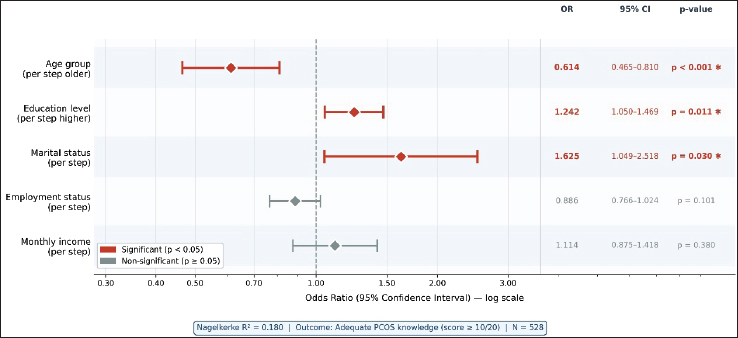
Figure 1. Forest plot of binary logistic regression predicting adequate PCOS knowledge (score .10/20) among women in the Asir region, Saudi Arabia (N = 528). Diamond markers represent odds ratios; horizontal bars represent 95% confidence intervals. PCOS = polycystic ovary syndrome; OR = odds ratio; CI = confidence interval.
Table 6. Multiple linear regression analysis of predictors of health-related practice score.
| Variable | β | SE | t | p -value | 95% CI | β (Std.) |
|---|---|---|---|---|---|---|
| Intercept | 29.844 | 3.094 | 9.646 | <0.001 | 23.780-35.908 | — |
| Knowledge Score | 0.261 | 0.068 | 3.813 | <0.001 | 0.127-0.394 | 0.176 |
| Age 26-35 years (ref: 18-25) | –3.500 | 1.658 | –2.111 | 0.035 | –6.750 to –0.250 | –0.131 |
| Age 36-45 years | –3.666 | 1.807 | –2.028 | 0.043 | –7.208 to –0.124 | –0.136 |
| Age >45 years | –2.011 | 1.949 | –1.032 | 0.303 | –5.830 to 1.809 | –0.107 |
| Diploma education (ref: Bachelor) | –2.329 | 1.148 | –2.029 | 0.043 | –4.579 to –0.079 | –0.100 |
| Intermediate education | –1.836 | 2.148 | –0.855 | 0.393 | –6.047 to 2.374 | –0.037 |
| Primary education | –0.449 | 1.940 | –0.232 | 0.817 | –4.253 to 3.354 | –0.011 |
| Secondary education | –0.843 | 0.935 | –0.902 | 0.367 | –2.676 to 0.989 | –0.055 |
| Master’s degree | –0.057 | 2.204 | –0.026 | 0.979 | –4.377 to 4.263 | –0.001 |
| PhD or equivalent | 0.158 | 2.823 | 0.056 | 0.956 | –5.375 to 5.690 | 0.003 |
| Married (ref: Divorced) | 0.807 | 2.207 | 0.366 | 0.715 | –3.518 to 5.133 | 0.028 |
| Single | –0.059 | 2.643 | –0.022 | 0.982 | –5.239 to 5.122 | –0.002 |
| Widowed | 0.654 | 3.098 | 0.211 | 0.833 | –5.418 to 6.727 | 0.010 |
| Retired (ref: Employed) | 4.543 | 1.449 | 3.134 | 0.002 | 1.702-7.383 | 0.191 |
| Housewife | 1.780 | 1.274 | 1.397 | 0.163 | –0.717 to 4.277 | 0.078 |
| Self-employed | –0.188 | 2.866 | –0.065 | 0.948 | –5.804 to 5.429 | –0.005 |
| Student | –3.279 | 1.633 | –2.008 | 0.045 | –6.479 to –0.079 | –0.139 |
| Unemployed | –1.146 | 1.250 | –0.917 | 0.360 | –3.596 to 1.304 | –0.059 |
| Income <3,000 SAR (ref: 3,000-5,000) | –0.727 | 1.163 | –0.625 | 0.532 | –3.007 to 1.553 | –0.034 |
| Income >5,000 SAR | –1.744 | 1.200 | –1.453 | 0.147 | –4.096 to 0.608 | –0.079 |
Note. Model: F(20,507) = 2.17, p = 0.004; R² = 0.079, Adjusted R² = 0.042. N = 528. Bold = p <0.05.
Predictors of health-related practices
A second multiple linear regression demonstrated that PCOS knowledge was the strongest independent predictor of healthier lifestyle practices (Table 6), underscoring that disease literacy directly translates into better health behavior. Employment status also independently shaped practice scores: retired women showed the highest practice engagement, consistent with their having more time for health-maintenance activities, while students, despite good knowledge had significantly lower practice scores, suggesting that knowledge alone is insufficient without supportive structural conditions. Younger and diploma-educated women also showed independently lower practice levels, pointing to specific subgroups where targeted behavioral interventions are warranted.
Correlation between PCOS knowledge and health-related practices
PCOS knowledge was positively and significantly correlated with overall health practice scores (ρ = 0.121, p = 0.006), indicating that better-informed women tended to engage in healthier behaviors. This relationship was most pronounced for exercise adherence and nutrition label-reading behaviors that require active decision-making informed by health literacy. Low-salt food incorporation was the only item unrelated to knowledge, suggesting that salt reduction may be driven by cultural or taste preferences rather than disease awareness. Full item-level correlations are reported in Supplementary Table 7.
Discussion
This study assessed PCOS knowledge and health-related practices among 528 women in the Asir region, Saudi Arabia. Despite 83.9% of participants having heard of PCOS and high recognition of hallmark symptoms, including menstrual irregularity (83.5%) and hirsutism (67.8%), understanding of PCOS as a systemic cardiometabolic disorder was markedly limited. Overall, 45.1% demonstrated poor knowledge, 38.1% moderate, and only 16.9% good, fewer than one in five achieving adequate disease literacy. Despite widespread awareness of obesity (76.5%) and insulin resistance (47.5%) as causal factors, far fewer recognized long-term complications, including diabetes (28.6%) and cardiovascular disease (13.8%).
Treatment misconceptions were prevalent. Over half of participants (51.1%) believed surgery to be a primary treatment option, reflecting misinformation in public discourse, while only 34.8% recognized metformin as an effective therapy. Evidence-based guidelines from the Endocrine Society prioritize hormonal contraceptives, recommend lifestyle modification, and reserve insulin-sensitizing agents for selected indications rather than first-line use [5]. A population-based study similarly highlighted that socioeconomic barriers compound clinical complications in PCOS and emphasized population-level lifestyle interventions as essential management strategies [10], a perspective directly supported by our findings.
Comparison with a study conducted among female medical students at King Khalid University [16] reveals instructive contrasts. General awareness was comparably high (83.9% in our cohort), yet only 42.6% of our participants correctly identified elevated androgen levels as a feature of PCOS, and only 50.0% recognized vaginal ultrasound as a diagnostic tool [4], compared with substantially higher awareness of diabetic (62.5%) and cardiovascular complications (54.5%) among medical students [16]. This contrast underscores how formal medical education consolidates PCOS knowledge in ways that general public education currently does not achieve.
The underappreciation of cardiometabolic risk is particularly concerning. While infertility (71.6%) and psychological consequences (69.1%) were well-recognized, the high “Don’t Know” response rates for heart disease (66.5%) and diabetes (60.4%) confirm that the metabolic dimension of PCOS remains invisible to the general public. This gap is clinically significant given that women with PCOS exhibit progressive deterioration of carbohydrate and lipid markers with advancing age, with biochemical hyperandrogenism persisting without normalization across the reproductive lifespan [9], contributing to long-term cardiometabolic consequences associated with unrecognized PCOS [2,17].
Our findings align closely with those of a cross-sectional study from the UAE [8]. Both studies demonstrated comparably high term-level familiarity with PCOS (83.9% vs. 84.3%). Awareness of hormonal dysregulation was higher in our sample (82.4% vs. 39.6%), as was recognition of obesity as a contributing factor (76.5% vs. 48.1%), differences that may reflect variation in health education approaches between the two Gulf populations. Both studies, however, shared marked deficits in understanding long-term risks and diagnostic pathways. While the UAE study identified prior PCOS diagnosis, medical background, and social proximity to an affected individual as key knowledge predictors [8], our multivariate regression identified older age (β = −3.092, p = 0.014) and lower educational attainment, specifically intermediate (β = −3.627, p = 0.009) and primary schooling (β = −2.575, p = 0.041) as the only independent negative predictors after controlling for all covariates. Bivariate analyses showed that higher education was associated with better knowledge, consistent with findings among Pakistani undergraduates [18] and similar observations in other populations [19], and that students had the highest mean knowledge scores (12.45 ± 4.50), reflecting ongoing academic health exposure. Retired women (mean 8.56 ± 4.78) and those with low educational attainment represent the highest-priority target groups for outreach.
Health-related practices were suboptimal. Fiber-rich food consumption was the most reported behavior (42.3%), yet only 15.0% consumed five daily servings of fruits and vegetables, and 43.6% reported never or rarely exercising. Spearman’s correlation (Supplementary Table 7) demonstrated a significant positive association between knowledge and practice scores (ρ = 0.121, p = 0.006), and multivariate regression confirmed that each additional knowledge point independently predicted a 0.26-point rise in practice score (β = 0.261, p < 0.001), most notably for nutrition label reading (ρ = 0.121, p = 0.005) and regular exercise (ρ = 0.141, p = 0.001). This contrasts with a study from Malaysia [20], which found no significant knowledge–practice association (p = 0.297), suggesting that contextual and cultural factors modulating this relationship differ between Gulf and Southeast Asian populations. Notably, retired women achieved the highest mean practice scores (32.24 ± 7.09; H = 11.58, p = 0.041), while students had significantly lower practice scores than employed women (β = −3.279, p = 0.045) despite higher knowledge, underscoring that knowledge alone is insufficient to drive behavior change without supportive structural conditions.
Several limitations warrant consideration. Non-probability convenience sampling via an online platform introduces selection bias, overrepresenting younger, educated, and urban women, which limits generalizability to the broader Asir population. All outcomes are self-reported, with no objective clinical data collected, introducing potential social desirability and recall bias. The cross-sectional design precludes causal inference, and the modest explained variance in both regression models (knowledge R² = 14.0%; practices R² = 7.9%) indicates that important predictors, including healthcare access, prior PCOS diagnosis, and media exposure, remain unmeasured. Future research should emphasize well-designed longitudinal and interventional studies, standardized outcome measures, and evaluation of intervention effectiveness, including education and models of care, to improve PCOS-related health outcomes across diverse populations [21].
The high baseline awareness (83.9%) provides a foundation for educational initiatives; however, persistent deficits in cardiometabolic risk knowledge and evidence-based treatment awareness indicate that education must move well beyond symptom recognition. Healthcare providers should integrate routine PCOS screening and counselling into women’s health services, with targeted messaging to correct surgical misconceptions and empower women, particularly older and less-educated groups, with actionable knowledge about lifestyle modification and pharmacological options.
Conclusion
This study reveals substantial gaps in PCOS knowledge among women in the Asir region, with fewer than one in five achieving good knowledge levels. Awareness of cardiometabolic complications and evidence-based management options was particularly deficient, while treatment misconceptions remained widespread. Older age and lower educational attainment were the strongest independent predictors of inadequate knowledge, and greater disease literacy was associated with healthier lifestyle practices. These findings underscore the urgent need for targeted, accessible educational interventions and the integration of PCOS screening and counselling into routine women’s health services, with special attention to older and less-educated populations. Future research employing representative sampling and objective clinical endpoints is warranted to further elucidate the knowledge–practice–outcomes relationship.
List of Abbreviations
CI Confidence Interval
IQR Interquartile Range
IUD Intrauterine Device
KR-20 Kuder-Richardson Formula 20
OR Odds Ratio
PCOS Polycystic Ovary Syndrome
SAR Saudi Riyals
SD Standard Deviation
SPSS Statistical Package for the Social Sciences
Conflict of interest
The authors declare that there is no conflict of interest regarding the publication of this article.
Funding
None.
Consent to participate
Completion of the online questionnaire implied informed consent. The survey was anonymous, and no personally identifiable information was collected.
Consent for publication
Not applicable (no individual patient data or identifiable information is included in this article).
Ethical approval
Ethical approval was granted by the Research Ethics Committee of King Khalid University via reference/letter number HAPO-06-B-001, Approval Number ECM#2024-2702, dated: 10 September 2024.
Author details
Norah I. Almanie¹, Sohaila Ahmed Asiri², Taif Khalid Alasmari², Norah Saad Jadaan², Thikra Khalid Alasmari², Yusra Abdullah AlQasimi², Ayman Shaamash1
- Department of Obstetrics and Gynecology, College of Medicine, King Khalid University, Abha, Saudi Arabia
- College of Medicine, King Khalid University, Abha, Saudi Arabia
Supplementary content (if any) is available online.
References
- Pundir C, Deswal R, Narwal V, Dang A. The prevalence of polycystic ovary syndrome: a brief systematic review. J Hum Reprod Sci. 2020;13(4):261–71. https://doi.org/10.4103/jhrs.JHRS_95_18
- March WA, Moore VM, Willson KJ, Phillips DIW, Norman RJ, Davies MJ. The prevalence of polycystic ovary syndrome in a community sample assessed under contrasting diagnostic criteria. Hum Reprod. 2010;25(2):544–51. https://doi.org/10.1093/humrep/dep399
- Bukhari T, Babaqi L, Alhariry AJ, Alqahtani L, Alkhayrallah S, Alalwani W, et al. Prevalence and awareness assessment towards Polycystic Ovary Syndrome (PCOS) among Saudi females in the western region of Saudi Arabia. Med Sci. 2023;27:e339. https://doi.org/10.54905/disssi/v27i138/e339ms3170
- Alsibyani NA, Malibary MA, Derham AA. Clinical presentation of polycystic ovary syndrome among Saudi Arabian women - Jeddah - Saudi Arabia. Egypt J Hosp Med. 2017;67(1):494–8. https://doi.org/10.12816/0036667
- Legro RS, Arslanian SA, Ehrmann DA, Hoeger KM, Murad MH, Pasquali R; Endocrine Society, et al. Diagnosis and treatment of polycystic ovary syndrome: an Endocrine Society clinical practice guideline. J Clin Endocrinol Metab. 2013;98(12):4565–92. https://doi.org/10.1210/jc.2013-2350
- Gade A, Sawant R, Parkar S, Kegade P. Polycystic ovary syndrome: an overview, diagnosis and treatment of PCOS. Asian J Pharm Technol. 2020;10(4):265–72. https://doi.org/10.5958/2231-5713.2020.00044.6
- Piltonen TT, Ruokojärvi M, Karro H, Kujanpää L, Morin-Papunen L, Tapanainen JS, et al. Awareness of polycystic ovary syndrome among obstetrician-gynecologists and endocrinologists in Northern Europe. PLoS One. 2019;14(12):226074. https://doi.org/10.1371/journal.pone.0226074
- Zaitoun B, Al Kubaisi A, Alqattan N, Alassouli Y, Mohammad A, Alameeri H, et al. Polycystic ovarian syndrome awareness among females in the UAE: a cross-sectional study. BMC Womens Health. 2023;23(1):181. https://doi.org/10.1186/s12905-023-02318-y
- De Medeiros SF, Yamamoto MMW, Souto De Medeiros MA, Barbosa BB, Soares JM, Baracat EC. Changes in clinical and biochemical characteristics of polycystic ovary syndrome with advancing age. Endocr Connect. 2020;9(2):74–89. https://doi.org/10.1530/EC-19-0496
- Alenzi EO, Alqntash NH, Almajed EH, Alzabin AK. Risk of polycystic ovary syndrome: a population-based analysis of sociodemographic factors, healthcare access, health behaviors, and health status. BMC Women’s Health. 2024;24(1):623. https://doi.org/10.1186/s12905-024-03446-9
- Alqntash N, Alzabin A, Almajed E, Alotaibi K, Alhindi G, Ali SI, et al. Polycystic ovary syndrome: a comprehensive exploration of diagnosis experience in Saudi women. J Clin Med. 2024;13(17):5305. https://doi.org/10.3390/jcm13175305
- General Authority for Statistics (Kingdom of Saudi Arabia). Data Saudi: Aseer region. 2023. Available from: https://datasaudi.sa/ar/region/aseer. Accessed 31 July 2024.
- Worldometers. Saudi Arabia population. 2023. Available from: https://www.worldometers.info/world-population/saudi-arabia-population/. Accessed 31 July 2024.
- Monsha’at Small and Medium Enterprises General Authority. Atlas: Aseer region profile. 2023. Available from: https://atlas.monshaat.gov.sa/ar/profile/region/aseer. Accessed 31 July 2024.
- Yamane T. Statistics: an Introductory Analysis. 2nd ed.; New York: Harper and Row; 1967.
- AlQasem MH, Alfaifi HM, Alqarni AM, Alnefaie W, Alshahrani RR. Prevalence and knowledge of polycystic ovary syndrome (PCOS) among female medical students, King Khalid University. Bahrain Med Bull. 2024;46(3):2290–5.
- Geraci G, Riccio C, Oliva F, Gabrielli D, Colivicchi F, Grimaldi M, et al. Women with PCOS have a heightened risk of cardiometabolic and cardiovascular diseases: statement from the Experts Group on Inositol in Basic and Clinical Research and PCOS (EGOI-PCOS) and Italian Association of Hospital Cardiologists (ANMCO). Front Cardiovasc Med. 2025;12:1520490. https://doi.org/10.3389/fcvm.2025.1520490
- Rizvi M, Islam MA, Aftab MT, Naqvi AA, Jahangir A, Ishaqui AA, et al. Knowledge, attitude, and perceptions about polycystic ovarian syndrome, and its determinants among Pakistani undergraduate students. PLoS One. 2023;18(5):285284. https://doi.org/10.1371/journal.pone.0285284
- Zahdeh M, Hallak H. Knowledge, perception, and management of polycystic ovary syndrome among women in Palestine: a mixed-method study. Womens Health (Lond Engl). 2025;21:17455057251333270. https://doi.org/10.1177/17455057251333270
- Goh JE, Farrukh MJ, Keshavarzi F, Yap CS, Saleem Z, Salman M, et al. Assessment of prevalence, knowledge of polycystic ovary syndrome and health-related practices among women in klang valley: a cross-sectional survey. Front Endocrinol (Lausanne). 2022;13:985588. https://doi.org/10.3389/fendo.2022.985588
- Teede HJ, Gibson M, Laven J, Dokras A, Moran LJ, Piltonin T, et al. International PCOS guideline clinical research priorities roadmap: a co-designed approach aligned with end-user priorities in a neglected women’s health condition. EClinicalMedicine. 2024;78:102927. https://doi.org/10.1016/j.eclinm.2024.102927
Keywords: Cross-sectional study, health practices, knowledge, polycystic ovary syndrome, Saudi Arabia.


Publication History
Received: March 23, 2026
Revised: April 15, 2026 Revised: April 20, 2026
Accepted: April 28, 2026
Published: June 19, 2026
Authors
Norah I. Almanie
Department of Obstetrics and Gynecology, College of Medicine, King Khalid University, Abha, Saudi Arabia.
 ORCID
ORCID
Yusra Abdullah AlQasimi
College of Medicine, King Khalid University, Abha, Saudi Arabia.
Ayman Shaamash
Department of Obstetrics and Gynecology, College of Medicine, King Khalid University, Abha, Saudi Arabia.