Annals of Middle Eastern Medicine
Amenah Alghamdi et al. Annals of Middle Eastern Medicine. 2026;2(1):022-027
ORIGINAL ARTICLE
Knowledge and attitude towards organ donation among medical and health science students at King Abdulaziz University
Amenah Alghamdi1, Roaa Mohammed Aljehani2, Layan Yassin Khan2, Amal Ahmed Alrajhi2, Lama Abdulkarim Aljohani2*, Nouf Hassan Alshareef1, Ragad Saad Jalmood2, Shahad Abdullah Alharbi2, Atheer Abdulmohsen Alharbi2
Correspondence to:Lama Abdulkarim Aljohani
*Medical Student, King Abdulaziz University, Jeddah, Saudi Arabia.
Email: laljuhani92@gmail.com
Full list of author information is available at the end of the article.
Received: 20 February 2026 | Revised (1): 24 February 2026 | Revised (2): 27 February 2026 | Accepted: 04 March 2026
ABSTRACT
Background:
Organ donation is lifesaving for many patients with underlying end-organ failure. Global interest in organ donation has increased in the last few years. However, awareness and ethical dilemmas surrounding organ donation can vary. This study was conducted to assess the knowledge and attitude toward solid organ donation among medical and health science students at King Abdulaziz University.
Methods:
We conducted a cross-sectional questionnaire-based study that was distributed to King Abdulaziz University medical and health science students to analyze their knowledge and attitudes towards organ donation.
Results:
A total of 224 participants were included in the analysis. The majority of participants (74.6%) agreed with organ donation and had positive attitudes towards it. No association was found between level of training and knowledge (p = 0.441). However, there was a significant association between knowledge and enrolment at the faculty of medicine (p = 0.0001) and between basic knowledge and gender (p = 0.028). The topic of organ donation and transplantation was felt to be adequately covered in the current curriculum by 28.1%, whereas 87.1% preferred having designated lectures or seminars incorporated into the curriculum.
Conclusion:
There was a predominance of positive attitudes towards organ donation and transplantation. However, organ donation and transplantation knowledge was limited. The majority of participants felt the need to have more training in organ donation and transplantation, highlighting the need for curriculum development and changes.
Keywords:
Organ, donation, awareness, knowledge.
Introduction
Solid organ transplantation is a crucial and life-saving management modality for patients with many end-organ illnesses [1,2]. Additionally, organ transplant is thought to drastically improve the quality of life of those in need of a solid organ transplant [2,3]. Organ transplantation also has a positive impact on health economics as it mitigates the socioeconomic burden of organ failure [2]. The global interest in organ donation and transplantation has risen significantly over the recent 20 years [1].
According to the 2023 data from the International Registry on Organ Donation and Transplantation, the actual rate for deceased donors donation in Saudi Arabia was 4.08 per million population (PMP), while the rate for living donors donation was 46.42 PMP [4]. Comparing these rates to other countries showcases the striking lower rates of deceased donors donation and higher rates of living donors donation in Saudi Arabia. In the United States, for example, the rate of actual deceased donors donation for the same year was 48.04 PMP, with a rate of 20.45 PMP for living donors donation [5]. The most frequently transplanted organ in Saudi Arabia in 2023 was the kidney, with a rate of 35.14 PMP and 5.06 PMP for living and deceased organ transplantation, respectively. Liver transplantation had a rate of 11.28 and 2.65 PMP for living and deceased organ transplantation, respectively. As for the heart, lungs, and pancreases, the rates were 1.54 PMP, 1.14 PMP, and 0.5 PMP, respectively [4].
These lower rates of deceased donors donation in Saudi Arabia showcase the very small pool of deceased donors available in Saudi Arabia. This area is worthy of a thorough assessment to identify factors leading to this pattern. One area that was examined in the literature is knowledge and attitudes towards organ donation and transplantation. Literature has identified common areas for misconceptions and misunderstandings pertaining to organ donation and transplantation knowledge. A 2017 survey conducted in Al-Kharj City among adult attendees of two hospitals found that 35.6% of participants were unaware that organ donation is legal in Saudi Arabia, and 97% did not know how to register as organ donors [6]. In a 2023 national survey assessing public awareness and attitudes toward organ donation, being male, aged 31-50 years, married, unemployed, or employed in a government position was associated with a lower likelihood of a positive attitude toward organ donation [2]. Another 2023 survey reported high overall unwillingness to donate organs (63%), with higher rates observed among males, individuals older than 30 years, and those working outside the health sector [7].
Organ donation attitudes and knowledge gaps for medical and health science students are expected to be different from those of the general population. Alwably and Algadaa [8] conducted a survey-based study on medical students at Al-Qassim University and identified certain gaps in medical students knowledge. Their analysis showed that only 24.6% of participants knew about the Saudi Center for Organ Transplantation, with only 29.9% thinking they had sufficient organ donation knowledge [8]. A study by Omran et al. [9] showed 61.1% of medical students had poor organ transplantation knowledge. This study was able to identify a significant association between the knowledge level and academic year [9]. Studies show that medical students still have hesitations regarding organ donation. One study showed 42.5% of participants were willing to register for organ donation [8]. A study by Alshareef and Smith [10] showed that only 33% of their participants agreed with transplantation from a brain-dead partner, with 30.2% believing that registered donors might receive premature termination of medical management.
Given global trends of rising demand for organ transplantation amid persistent donor shortages [6], further research assessing public attitudes and knowledge gaps regarding organ donation may help clarify barriers contributing to donor unavailability.
This study aims to evaluate the knowledge and attitudes of medical and health science students at King Abdulaziz University (KAU) toward solid organ donation and transplantation, to assist in implementing curriculum changes.
Methods
Study design, setting, and population
This study is an observational cross-sectional study examining knowledge and attitudes towards organ donation among medical and health science students at KAU in Jeddah, Saudi Arabia. The study was conducted from March 2023 to June 2024.
Participants were included in the study if they were medical and health science students, currently enrolled at KAU in Jeddah. Participants were excluded from the study if they were students at universities other than KAU; if they were students in a specialty other than medicine and health sciences, or if they were not students.
Study tool
A structured self-administered questionnaire was designed using the Google Forms web application. The questionnaire consisted of 4 sections encompassing questions related to demographic information, opinions regarding organ donation, organ donation and transplantation knowledge, and opinions regarding the studied curriculum and areas for improvement. The questionnaire was distributed to students enrolled in the medical and health science programs at KAU through email and other social media platforms.
Table 1. Characteristics of responses.
| Characteristic | Number (percentage) n = 224 |
|---|---|
| Gender - Female - Male | 182 (81.2%) 42 (18.8%) |
| Age - 17-19 - 20-22 - 23-25 - 26-28 | 14 (6.3%) 98 (43.8%) 105 (46.9%) 7 (3.1%) |
| Year of study - Second year - Third year - Fourth year - Fifth year - Sixth year - Internship year | 19 (8.5%) 20 (9%) 52 (23.3%) 83 (37.2%) 31 (13.9%) 18 (8.1%) |
| Faculty - Faculty of Medicine - Faculty of Dentistry - Faculty of Nursing - Faculty of Applied Medical Sciences | |
| 187 (83.9%) 15 (6.7%) 11 (4.9%) 10 (4.5%) |
Data collection and analysis
We collected data electronically using the Google Forms web application and then pooled the data into an Excel database (Microsoft Corp., Redmond, WA, USA), where descriptive statistics were performed. Fisherfs exact test and chi-square tests were used for categorical variables, as appropriate. P-value . 0.05 was considered as statistically significant
A structured questionnaire was developed by the study team after reviewing the relevant literature on organ donation knowledge and attitudes. The draft instrument underwent content review by [e.g., two faculty experts] and was piloted on [n] students to assess clarity and comprehensibility. The final questionnaire is provided in Supplementary File 1.
Results
We had a total of 236 responses,12 of whom were excluded (1 did not consent and 11 failed to meet the inclusion criteria). Demographics of the remaining 224 participants are shown in Table 1. Approximately 18.8% of participants had relatives who had received organ transplantation; 4.5% had friends who were transplant recipients; and 1.3% (n = 3) were transplant recipients themselves. The majority knew no transplant recipients (75%), Table 1.
Opinions regarding organ donation
The majority of respondents were in agreement with the concept of organ donation (74.6%). Only 4.9% disagreed with organ donation, and 20.5% remained neutral. Reasons for being in disagreement with organ donation are shown in Figure 1. Reasons for being in agreement with organ donation are shown in Figure 2. The majority of participants (70.5%) stated that they would encourage their loved ones to register for organ donation. This was not associated with having known an organ transplant recipient personally (p = 0.175). Reasons for considering listing for organ donation are shown in Figure 3.
Organ donation and transplantation knowledge
Knowledge was assessed using several items. First, participants knowledge of organ donation mechanisms and related aspects in Saudi Arabia was evaluated. Most participants recognized that organ transplantation is legal in Saudi Arabia (215/226, 96%). However, only 58.9% identified the kidney as the most commonly donated organ in the country. Overall, 126 participants (56.8%) correctly identified all available registration portals, including the Tawakkalna application/website and the Saudi Center for Organ Transplantation website.
Table 2. Chi-square analysis of factors associated with organ donation knowledge.
| Comparison (Independent variable → Outcome) | χ² | df | Exact p-value Interpretation | |
|---|---|---|---|---|
| Level of training → Knowledge | 1.64 | 2 | 0.441 | Not statistically significant |
| Enrollment in Faculty of Medicine → Knowledge | 26.479 | 6 | 0.0001 | Statistically significant association |
| Gender → Basic knowledge | 7.17 | 2 | 0.028 | Statistically significant association |
Figure 1. Reasons for disagreement with organ donation for participants in disagreement with organ donation (n = 11). X-axis: reason for disagreement with organ donation. Left Y-axis (bars): number of participants selecting the reason (count). Right Y-axis (line): participants selecting the reason (% of n = 11). Multiple selections were allowed.
Figure 2. Reasons for agreement with organ donation for participants in agreement with organ donation (n = 167). X-axis: reason for agreeing with organ donation. Left Y-axis (bars): number of participants selecting the reason (count). Right Y-axis (line): participants selecting the reason (% of n = 167). Multiple selections were allowed.
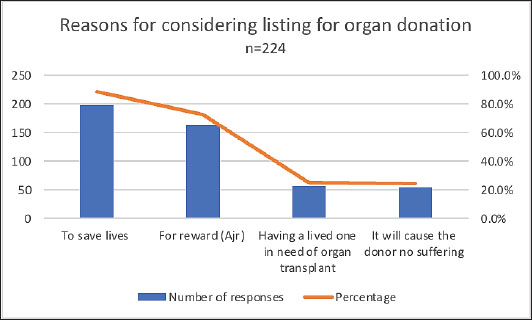
Figure 3. Reasons for considering listing for organ donation among all participants (n = 224). X-axis: reason for considering registering/listing for organ donation. Left Y-axis (bars): number of participants selecting the reason (count). Right Y-axis (line): participants selecting the reason (% of n = 224). Multiple selections were allowed.
Regarding what donor registration entails, 42.4% of participants were unsure, and 19.6% believed that registration places an individual on a list for living donation once a suitable match is found. In contrast, 37.9% correctly understood that registration means pledging one’s organs for donation in the event of brain death.
Second, general basic knowledge regarding organ donation and transplantation was assessed by analyzing responses to 8 general knowledge questions that are shown in appendix 1. Analysis showed that 40.6% answered 7-8 answers correctly; 42.4% had 5-6 correct answers, while 17% of the respondents had answered 4 or less questions correctly. No association was found between level of training and knowledge (X2 = 1.64, p = 0.441). However, there was a significant association between knowledge and faculty of enrolment (X2 = 26.479, p = 0.0001), and between basic knowledge and gender (X2 = 7.17, p = 0.028). Female participants were more likely to answer 7-8 questions accurately compared to male participants (OR = 2.57, 95% CI 1.19-5.53, p = 0.016). Participants enrolled in the faculty of Medicine were more likely to answer 7-8 questions correctly compared to those enrolled at other faculties (OR = 4.17, 95% CI, 1.66-10.48, p = 0.0024) Table 2.
Curriculum
Looking at the current curriculum, 28.1% of the respondents thought that the current curriculum adequately covers the topic of organ donation; 30.8% felt that the topic is not adequately covered; and 41.1% felt that the topic is covered to some extent. The majority of the respondents had to use other resources to educate themselves about the topic (65.2%). Additionally, 146 participants (87.1%) preferred to have designated lectures or seminars discussing organ donation incorporated into the curriculum. The best time for such lectures or seminars was felt to be during the clinical years (years 4 through 6 of medical school) in 61.2% of the participants.
Discussion
Interest in organ donation and transplantation continues to grow as demand for transplantation rises. However, Saudi Arabia has lower rates of deceased-donor donation compared with many other countries [4,5], underscoring the need to explore factors contributing to this gap. In this study, we assessed the attitudes and knowledge of KAU medical and health sciences students regarding organ donation and transplantation to identify potential barriers to donor registration and to inform recommendations for any needed curricular enhancements.
The majority of our participants were females (81.2%); enrolled at the faculty of medicine (83.9%); and in their clinical years of studying (fourth year and higher) at 82.5%. We had an overall high level of organ donation acceptance (74.6%). This rate of acceptance was similar to other studies conducted in Saudi Arabia [9,10,11]. A survey-based study conducted by Altraif et al. [11] on outpatients and medical staff at King Abdulaziz Medical City showed that health-care professionals had better attitudes and knowledge concerning organ donation [11].
The most frequently cited reasons for acceptance of organ donation and transplantation in our study were to save a life and to save a family member’s life in 90.4% and 81.4% of participants. As for factors leading to disagreement, having a religious or belief reason and the idea of honouring the dead by burying them with all their organs were equally cited in 4 participants. When discussing factors influencing the decision to register for organ donation, “to save lives” and “for reward/ajr” were the most frequently reported factors by our participants.
Assessing our participants’ knowledge regarding organ donation and transplantation highlights certain variabilities. The majority of participants accurately recognized the legality of organ transplantation in Saudi Arabia (96%). However, only 56.8% were able to list all organ donation registration portals in Saudi Arabia, and only 37.9% showing understanding of what it entails to be an organ donor. Literature has shown more apparent knowledge gaps when examining the general population. A survey-based study by Agrawal et al. [6] that examined organ donation/transplantation knowledge amongst the general population showed that 35.6% of participants were not aware that organ donation is legal in Saudi Arabia, and that 97% lacked knowledge on how to register for organ donation. Vincent et al. [12] conducted a cross-sectional study amongst medical and nursing students in India and reported a much lower proportion of students who knew about the country’s law regarding organ donation (29.4%). Similar to our study, a Canadian survey-based study showed fewer students to be aware of all donation registries [13]. These differences between regions and populations highlight the importance of targeted population-specific approaches designed to meet the needs and to bridge any knowledge gaps.
Participants in our study had an overall good basic transplant knowledge, with only 17% scoring 4 or less correct answers. Analysis revealed no association between the level of training and knowledge, while there was a significant association between knowledge and both gender and faculty of enrolment. These results could have been skewed by the fact that the majority of participants in our study were female students enrolled at the faculty of medicine. However, other studies in the literature describe similar associations. Vincent et al. [12] show medical students in their cross-sectional study to have a statistically significant higher median for organ donation and transplant knowledge compared to nursing students.
Regarding the current curriculum, the majority of respondents in our study expressed that the topic of organ donation and transplantation is either not adequately covered or somewhat covered in the current curriculum. The majority of participants felt the need for this topic to be incorporated into the curriculum. This is consistent with research from other countries, where students also felt the need to receive more training in organ donation and transplantation [13]. Examining data from our study and from other studies highlights the need for adjustments to the current undergraduate medical curriculum to allow for the topic of organ donation and transplantation to be adequately covered in accordance with students’ needs.
Strengths of our study include the relevance of the topic, especially when considering the global increasing demand for organ transplantation and donation. Additionally, inclusion of all health care students in our study, rather than medical students alone, allows for more generalizability. Finally, the study has the potential to inform changes to the current medical curriculum.
A major limitation of our study is the cross-sectional nature of the study, which puts it at risk of certain biases, especially selection and recall bias. Another limitation is the small sample size, which limits heterogeneity and generalizability.
Conclusion
EBL during IVD independently predicts postpartum hemoglobin decline after adjustment for maternal and obstetric factors. A blood loss threshold of approximately 400 mL demonstrated acceptable discriminatory performance for identifying patients at risk of clinically significant hemoglobin reduction (≥2 g/dL). These findings suggest that EBL may serve as a practical tool for postpartum risk stratification and support consideration of selective early hemoglobin assessment in higher-risk patients.
List of Abbreviations
CC BY 4.0 Creative Commons Attribution 4.0
CI Confidence interval
IRB Institutional Review Board
KAU King Abdulaziz University
OR Odds ratio
PMP Per million population
USA United States of America
Conflict of interest
The authors declare no competing interests.
Funding
None.
Consent to participate
Not applicable.
Consent for publication
Not applicable.
Data availability
Not applicable.
IRB approval
Not applicable.
Ethical approval
Not applicable.
Author details
Amenah Alghamdi1, Roaa Mohammed Aljehani2, Layan Yassin Khan2, Amal Ahmed Alrajhi2, Lama Abdulkarim Aljohani2, Nouf Hassan Alshareef2, Ragad Saad Jalmood2, Shahad Abdullah Alharbi2, Atheer Abdulmohsen Alharbi2
- Department of Internal Medicine, King Abdulaziz University, Jeddah, Saudi Arabia
- Medical Student, King Abdulaziz University, Jeddah, Saudi Arabia
Supplementary content (If any) is available online.
References
- Somaili M, Masmali A, Haqawi I, Al-Hulaibi M, Alhabji AA, Salami A, et al. Knowledge and attitude toward organ donation among the adult population in Jazan, Saudi Arabia. Cureus. 2022;14(7):e27002. https://doi. org/10.7759/cureus.27002
- Alghamdi A, Alsaleh AA, Alfozan OA, Qutob R, Alaryni A, Bukhari A, et al. Awareness, attitude, and beliefs regarding organ donation among the general public in Saudi Arabia. Int J Gen Med. 2023;16:497389. https:// doi.org/10.2147/IJGM.S434589
- Burra P, De Bona M. Quality of life following organ transplantation. Transpl Int. 2007;20(5):397409. https://doi.org/10.1111/j.1432-2277.2006.00440.x
- International Registry on Organ Donation and Transplantation. Saudi Arabia data 2023 [cited 2026 Feb 18]. In: IRODaT database. Available from: https://www.irodat.org/?p=database&c=SA#data
- International Registry on Organ Donation and Transplantation. United States of America data 2023 [cited 2026 Feb 18]. In: IRODaT database. Available from: https://www.irodat.org/?p=database&c=US#data.
- Agrawal S, Binsaleem S, Al-Homrani M, Al-Juhayim A, Al- Harbi A. Knowledge and attitude towards organ donation among adult population in Al-Kharj, Saudi Arabia. Saudi J Kidney Dis Transpl. 2017;28(1):819. https://doi.org/10.4103/1319-2442.198150
- Alessa MY, Albedaiwi MS, Al Mousa AM, Alhassan GM, Alnefaie BT. Knowledge and attitude of organ donation in the Eastern region of Saudi Arabia and the influence of social media campaigns: a cross-sectional study. Ann Med Surg (Lond). 2023;85(3):394401. https://doi. org/10.1097/MS9.0000000000000258
- Alwably H, Algadaa A. Knowledge and attitude towards organ transplantation among medical students in the Medical College of Al Qassim University. Hamdan Med J. 2015;8. doi:10.7707/hmj.503
- Omran R, Yasawy MA, Al Harthi AA, Bokhari AY, Alabdali AS, Alzaidi MM, et al. Knowledge and attitude among medical students regarding organ donation in the western region of the Kingdom of Saudi Arabia. Int J Med Dev Ctries. 2020;4(8):113843. https://doi.org/10.24911/IJMDC.51-1589941975
- Alshareef S, Smith RM. Saudi medical students knowledge, attitudes, and beliefs with regard to organ donation and transplantation. Saudi J Kidney Dis Transpl. 2018;29(5):111527. https://doi.org/10.4103/1319- 2442.243963
- Altraif I, Altuwaijri N, Aldhbiban L, Alhoshan F, Alomari R, Moukaddem A, et al. Knowledge and attitude toward organ donation among medical staff and outpatients at King Abdulaziz Medical City, Riyadh, Saudi Arabia. Saudi J Kidney Dis Transpl. 2020;31(6):134450. https://doi. org/10.4103/1319-2442.308343
- Vincent BP, Kumar G, Parameswaran S, Kar SS. Knowledge, attitude, and perception on organ donation among undergraduate medical and nursing students at a tertiary care teaching hospital in the southern part of India: a cross-sectional study. J Educ Health Promot. 2019;8:161. https://doi.org/10.4103/jehp.jehp_439_18
- Robert P, Bgin F, Mnard-Castonguay S, Frenette AJ, Quiroz-Martinez H, Lamontagne F, et al. Attitude and knowledge of medical students about organ donation - training needs identified from a Canadian survey. BMC Med Educ. 2021;21:368. https://doi.org/10.1186/ s12909-021-02736-2
Keywords: Organ, donation, awareness, knowledge.


Publication History
Received: February 20, 2026
Revised: February 24, 2026 Revised: February 27, 2026
Accepted: March 04, 2026
Published: April 25, 2026
Authors
Amenah Alghamdi
Department of Internal Medicine, King Abdulaziz University, Jeddah, Saudi Arabia.
Roaa Mohammed Aljehani
Medical Student, King Abdulaziz University, Jeddah, Saudi Arabia.
Layan Yassin Khan
Medical Student, King Abdulaziz University, Jeddah, Saudi Arabia.
Amal Ahmed Alrajhi
Medical Student, King Abdulaziz University, Jeddah, Saudi Arabia.
Lama Abdulkarim Aljohani
Medical Student, King Abdulaziz University, Jeddah, Saudi Arabia.
Nouf Hassan Alshareef
Medical Student, King Abdulaziz University, Jeddah, Saudi Arabia.
Ragad Saad Jalmood
Medical Student, King Abdulaziz University, Jeddah, Saudi Arabia.
Shahad Abdullah Alharbi
Medical Student, King Abdulaziz University, Jeddah, Saudi Arabia.
Atheer Abdulmohsen Alharbi
Medical Student, King Abdulaziz University, Jeddah, Saudi Arabia.